
 Back to all Member Galleries
Talley Dunn Gallery
5020 Tracy Street
Dallas, TX 75205
Appointment Recommended
214 521 9898
Dallas, TX 75205
Appointment Recommended
214 521 9898


Talley Dunn Gallery is committed to exhibiting outstanding and groundbreaking contemporary art in a variety of media by established and emerging artists. With over twenty years of experience in the art world, Talley Dunn focuses on building lasting relationships with artists, collectors, curators, and critics from around the country and abroad.
Talley Dunn is firmly dedicated to building the careers of the artists that the gallery represents through exhibitions, acquisitions, publications, and projects. The gallery encourages the growth and development of its artists with an ambitious exhibition program and an ongoing dialogue with museum curators and art critics nationally and internationally.
In addition to organizing year-round exhibitions and programs at the gallery, Talley Dunn works continuously on off-site exhibitions and projects with museums, institutions, galleries and private collectors from coast to coast. This involvement broadens the audience for the artists that the gallery represents while providing opportunities for the artists to experiment with new ideas in varying environments.
Talley Dunn Gallery strongly believes in creating opportunities for racial equity in the Texas arts community. The Talley Dunn Gallery Equity in the Arts Fellowship strives to foster the development of emerging Black and Indigenous artists and other artists of color in North Texas, whose artmaking forms the backbone of our cultural landscape. In line with Talley Dunn Gallery’s ongoing commitment to anti-racism in our community, the gallery pledges to provide the fellowship with funding over the next five years with the hope that it continues indefinitely. This fellowship will be just one component of a larger vision for programming and resources the gallery will invest in supporting Black and Indigenous artists and other artists of color.
Artists Represented:
Nida Bangash
David Bates
Natasha Bowdoin
Julie Bozzi
Natasha Bowdoin
Julie Bozzi
Gabriel Dawe
Leonardo Drew
Vernon Fisher
Leonardo Drew
Vernon Fisher
Pia Fries
Francesca Fuchs
Francesca Fuchs
Ori Gersht
Kana Harada
Kana Harada
Jacob Hashimoto
Joseph Havel
Joseph Havel
Letitia Huckaby
Sedrick Huckaby
Butt Johnson
Eva Lundsager
Tina Medina
Vicki Meek
Melissa Miler
Melissa Miler
Arely Morales
Cynthia Mulcahy
Roxy Paine
Sam Reveles
Linda Ridgway
Sam Reveles
Linda Ridgway
Eli Ruhala
Matthew Sontheimer
Erick Swenson
Ursula von Rydingsvard
Matthew Sontheimer
Erick Swenson
Ursula von Rydingsvard
Sarah Williams
Xiaoze Xie
Xiaoze Xie
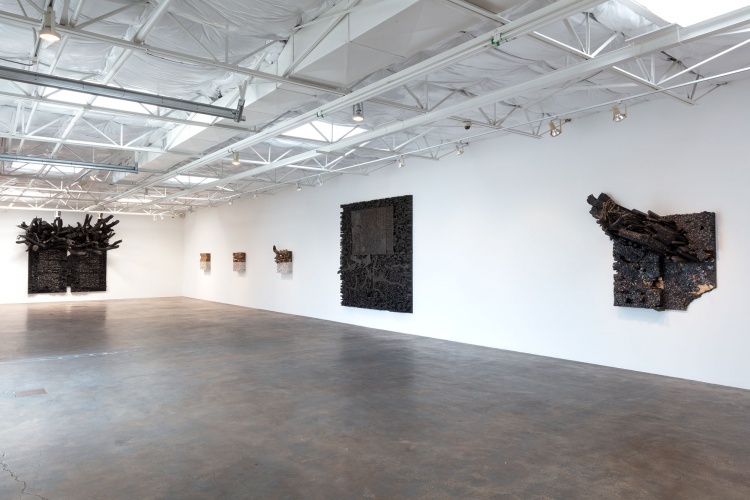
Leonardo Drew, Installation view, 2020, Talley Dunn Gallery
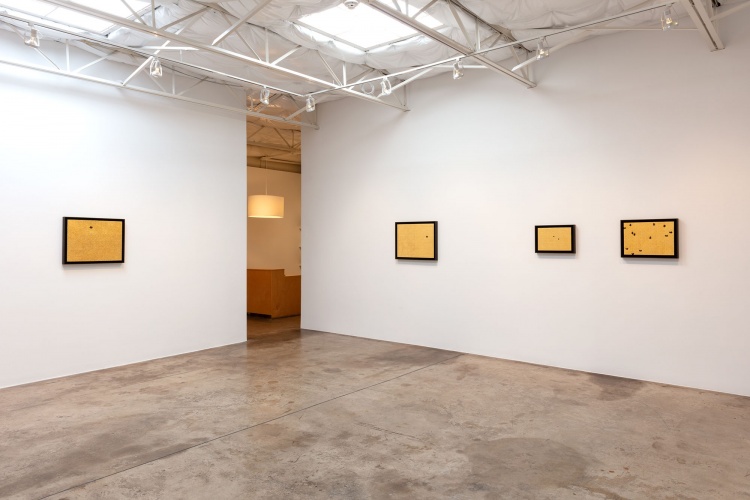
Gabriel Dawe, Found, Installation view, 2020, Talley Dunn Gallery
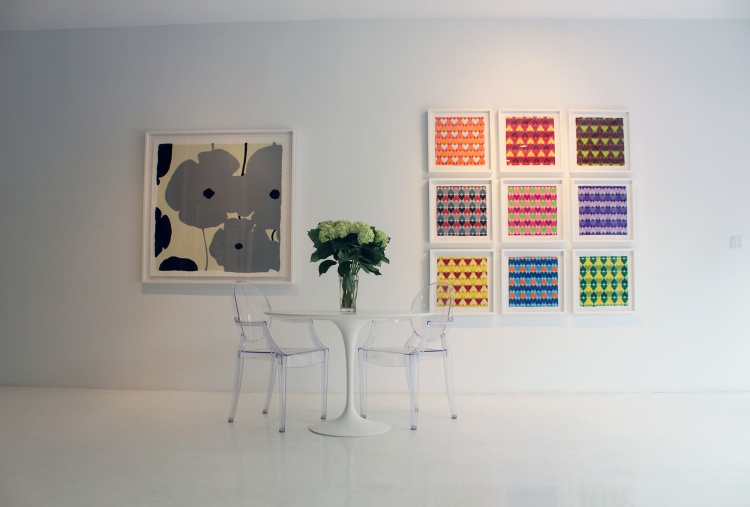
The viewing room
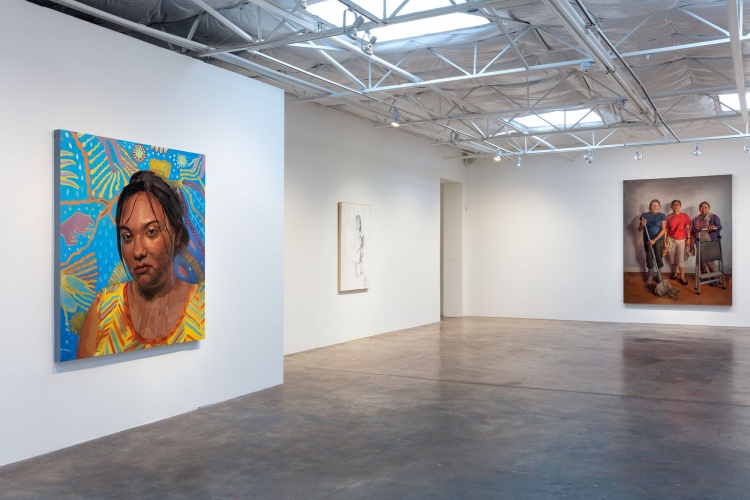
Arely Morales, Installation view, 2021, Talley Dunn Gallery
Roxy Paine, Overgrown Neuron, 2026 Installation view


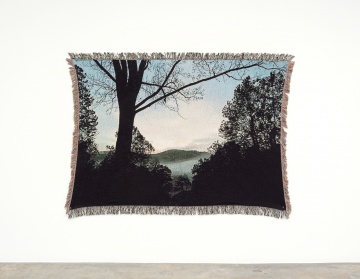
Letitia Huckaby
An Invitation to Madison County
October 10, 2026 - December 19, 2026
Talley Dunn Gallery is pleased to present renowned photographer and multimedia artist Letitia Huckaby and her exhibition An Invitation to Madison County on view October 10 through December 19, 2026. This exhibition features new work drawn from the artist’s Madison Project, a series of thirty-two woven textiles exploring the landscape, family, and history of Madison County, Virginia. Beginning with intensive research in early 2025 and numerous site visits, the artist delved into the rich and powerful history of Madison County and the surrounding area. Huckaby explored the fertile and lush landscape, historic buildings, and the elders of the community.
Central to the region is the former plantation, Montpelier. Built in 1764, Montpelier was the childhood home of James Madison as well as the place to which he returned after serving two terms as the 4th President of the United States in 1817. More than 300 enslaved individuals and six generations of families were connected to the Virginia plantation through slavery.
Throughout the series, Huckaby moves among people and places, bringing portraits into dialogue with landscapes and historic structures that bear the traces of generations. Her attention extends beyond Montpelier itself, examining how plantation histories remain present within the surrounding landscape and in the lives of descendants connected to them.
From hardwood forests to gravel roads and sacred ground, Huckaby explores the history of these places and their undeniable connections to the present. The scenes of nature transition to evocative imagery of historical structures, churches, homesteads, and gathering places presented on woven tapestries.
At the center of the project are elders from Madison County, many in their eighties and nineties and descendants of people enslaved at plantations throughout the region. Huckaby engages with individuals whose lives and experiences reflect different dimensions of the community—a seamstress, a historian, a musician, a pastor, and a groundsman—alongside the places where their stories have unfolded. At first glance, a middle school, an old store, a church, and a juke joint may appear as architectural subjects, but on closer examination they emerge as sites that have sustained community life and historical memory for centuries.
The works are rendered as woven textiles, extending Huckaby’s longstanding engagement with photography and materiality. By translating photographic images into cloth, Huckaby brings the tactile qualities of textiles to bear on the people, architecture, and landscapes she documents. The material becomes integral to how viewers encounter Huckaby’s photographs, emphasizing domesticity and family through their presence as objects and images.
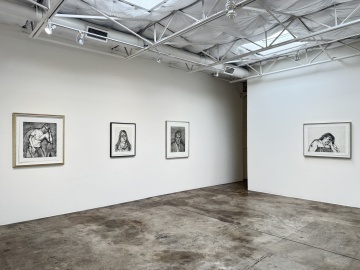
Lucian Freud
Lucian Freud: Etchings
September 12, 2026 - November 21, 2026
Talley Dunn Gallery is pleased to present Lucian Freud: Etchings, an exhibition devoted to the artist’s distinctive approach to portraiture in printmaking. Best known for his uncompromising paintings of the human figure, Freud also remained engaged with etching. Working directly on the copper plate, he approached the medium with the same intensity of observation that
defined his paintings and drawings. His closely worked lines trace the contours, textures, and physical presence of his subjects, revealing portraiture as a process of prolonged looking. Freud’s etchings are remarkable for their intimacy and psychological intensity. Often depicting sitters from his immediate circle, the works dispense with elaborate settings to focus on the face and body. Through variations in the density, direction, and accumulation of line, Freud creates images that convey physical likeness and the duration and intimacy of the encounter between artist and sitter. Presented together at Talley Dunn Gallery, these works invite consideration of printmaking as an essential dimension of Freud’s practice and his sustained investigation of the human figure.
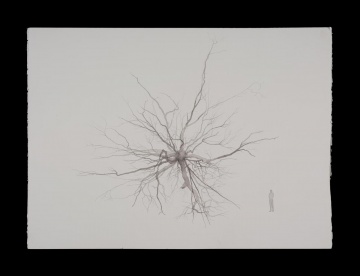
Roxy Paine
Overgrown Neuron
February 20, 2026 - May 9, 2026
Talley Dunn Gallery is delighted to present Roxy Paine: Overgrown Neuron. For the past year, the gallery has collaborated with Paine on a major monumental sculpture, Overgrown Neuron, commissioned for the University of Texas Southwestern Medical Center in Dallas, Texas. In celebration of this sculpture and its pending installation this spring on the UTSW campus, the gallery is thrilled to present an exhibition of drawings and studies for the commissioned sculpture.
One of the most important artists of his generation, Paine has distinguished himself nationally and internationally through ambitious projects, a rigorous studio practice, and a singularly unique vision. For this project, Paine references the dendrite forms for which he is renowned. Handmade from stainless steel at the artist’s studio and spanning nearly fifty feet in height, width, and depth, Overgrown Neuron, is a tour de force by Paine. From his studio in Red Lodge, Montana, the artist created the composition of the neuron first through detailed ink drawings and then turned to meticulously creating an intricate stainless-steel model of the subject before embarking on the outdoor sculpture. Both the drawings and the model of Overgrown Neuron are on view in the exhibition.
While Overgrown Neuron is one of only two unique monumental neurons Paine has created during his distinguished career, its connection to Paine’s tree-like sculptures known as “Dendroids” is unmistakable. Having created his first Dendroid, Impostor, for the Wanas Foundation in Knislinge, Sweden in 1999 and then his second Dendroid sculpture, Bluff, in Central Park New York for the Whitney Biennial in 2002, Paine embarked on an exploration of dendritic structures from a microscopic presence to a monumental scale. Exploring the branching tendrils that radiate from a cell body of a neuron often forming what is known within science as dendritic trees, Paine has translated this basic molecular form found throughout nature into works of enormous scale. Choosing the industrial material of stainless steel, Paine manipulates the metal by hand through an arduous process of compressing, bending, and stretching the stainless steel into elements that have fluidity and movement. Without the use of digital imaging or a foundry, Paine composes each element of his heroic sculptures through the visual interpretation of his drawings and models. His commitment to the process of creating these sculptures by hand translates from his most formidable outdoor sculptures to indoor works of comparable complexity and intention.