
 Back to all Member Galleries
Robert Mann Gallery
508 West 26th Street, Suite 4C
New York, NY 10001
Appointment Recommended
212 989 7600
New York, NY 10001
Appointment Recommended
212 989 7600


Robert Mann began working in the field of fine art photography in the mid 1970’s. Serving as director of the Lunn Gallery in Washington D.C. and the LIGHT Gallery in New York, Robert established his first gallery in 1985, operating from a salon space on Manhattan’s Upper East Side. In 1999 the gallery was one of the first to relocate to the newly emerging Chelsea art district. Throughout this time the gallery continued to expand its program in promoting classical 20th century photographers and estates along with contemporary artists, both mid career and emerging. The gallery is active in brokering secondary market material and in consulting on private and corporate collection management. We have placed collections and individual classical and contemporary works in many significant museum collections such as the Metropolitan Museum of Art, The Museum of Modern Art, The National Gallery of Art and the Nelson Atkins Museum of Art to name a few. The gallery exhibits both nationally and internationally, participating in numerous art fairs, and we publish monographs and catalogues to support the artists and estates that we represent.
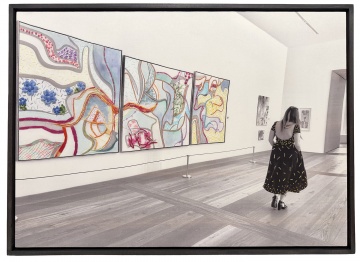
Orly Cogan
Orly Cogan: Behind the Lens & Through the Needle
September 10, 2026 - October 24, 2026
Celebrating our 35th year and kicking off the fall season in our newly constructed gallery space on the fourth floor of the famed West Chelsea Arts Building we are pleased to present: Orly Cogan: Behind the Lens & Through the Needle.
Long celebrated for her hand-stitched feminist embroidery artwork, Orly Cogan debuts a compelling new body of work that expands her distinctive practice by bringing photography and fiber art into a whimsical, imaginative dialogue.
Through needle and thread, she reveals the hidden energies embedded within works of art and the spaces in which they are displayed. By calling forth magical worlds concealed within art fairs, galleries, and museums, Cogan suggests that the act of viewing art can itself become a creative act.
Nature weaves through many of these works in lush bouquets of blossoms, where black-and-white imagery merges with intricate embroidery and richly layered three dimensional textures. Hidden among the flowers and foliage are unexpected moments of wonder waiting to be discovered. With subtle nods to the art of dance and the rhythms of the natural world, these pieces exist between memory and imagination, carrying an ethereal sense of profusion in which the stitched and the photographed, the tangible and the dreamlike, intertwine.
Seen as a response to Susan Sontag’s suggestion that photographs are neat “slices” of the world forever frozen in time, Cogan’s hand and needle breathe life into pictures, an overtly feminine touch that yields a creative abundance, at times forcing the artworks to spill out of their frames. Cogan’s handwork, partnering with the mechanics of the photographic image, explores the tension between speed and slowness, reproduction and singularity. These works propose that meaning is not fixed within the image but emerges through encounter and engagement. It is within this space between photograph and thread, reality and invention, object and viewer, that the familiar is unsettled, allowing something unexpected to come vividly into being.
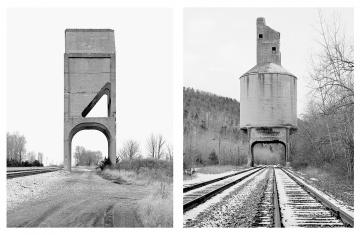
Jeff Brouws
Jeff Brouws: Silent Monoliths
October 29, 2026 - December 12, 2026
Robert Mann Gallery is pleased to announce Jeff Brouws: Silent Monoliths, an exhibition by American photographer Jeff Brouws (b. 1955) that showcases his landmark series documenting the architectural remnants of America’s railroad history, featured in his critically acclaimed book Silent Monoliths: The Coaling Tower Project (MIT Press, 2026). Acting as a "visual anthropologist," Brouws utilizes a precise, deadpan typological approach to capture these industrial monuments left behind by technological shifts across the United States.
Between 1907 and 1956, the country’s rapidly growing railway industry constructed hundreds of massive reinforced-concrete structures designed to hold several hundred tons of coal used to fuel steam locomotives. As the industry transitioned from steam to diesel throughout the 1950s, these behemoth structures eventually became obsolete. Although some were torn down, many have remained in place, acting as abandoned witnesses to the rise and fall of American railroading.
Over five years and covering more than 20,000 miles, Brouws systematically documented these dormant, sculptural artifacts: photographing each towering structure under flat, overcast light, he presents these silent monoliths as imposing, monumental testaments to the perplexing contradictions of modern industrialization.
Brouws’ Coaling Tower Project is an extension of his over 35 year career chronicling the shifting, multifaceted commercial and industrial topography of the American cultural landscape, using his camera to construct rigorous photographic typologies and deliberate narrative frameworks. His practice has investigated the socio-spatial and socio-economic remnants of mid-century idealism and subsequent late-stage capitalism—with subjects ranging from the interstate highway system and corporate sprawl to post-industrial urban decay.
His work directly engages in a critical dialogue with the New Topographics movement, which reframed the American landscape by focusing on man-altered spaces rather than pristine nature. Brouws also builds upon the pioneering strategies of forebears like Ed Ruscha and Bernd and Hilla Becher, preserving the ephemeral iconography of the American built environment. By capturing sites of obsolescence and neglect, the spaces he photographs become melancholic meditations on an ever-changing, ever-evolving national identity.
Complementing these large black-and-white photographs of coal towers in an adjunct installation is a grid of color works from Brouws’ series Signs Without Signification. In stark contrast to the heavy concrete of the coaling towers, this portfolio examines the skeletal, stripped frameworks of defunct commercial signage. Together, these twin typologies transform images of industrial infrastructure and commercial decay into a contemplative commentary on the collective, fading landscape of America’s built environment.
Join us on Thursday, October 29 for an opening reception and book signing with the artist.

Holly Andres, Julie Blackmon, Sandra Cattaneo Adorno, Cig Harvey, Maroesjka Lavigne, Mary Mattingly, Susan Rankaitis, Jennifer Williams
How She Sees: Redux
July 7, 2026 - August 15, 2026
Robert Mann Gallery is happy to announce the opening of its new location in Suite 4C within the West Chelsea Arts Building on West 26th Street. Currently on view, How She Sees: Redux. Referencing our original 2021 exhibition that featured black-and-white prints by early-twentieth century women photographers, this updated version highlights contemporary works made by several female artists that invite viewers into imaginative environments.
With works by Holly Andres, Julie Blackmon, Sandra Cattaneo Adorno, Cig Harvey, Maroesjka Lavigne, Mary Mattingly, Susan Rankaitis, and Jennifer Williams.

Gold Standards: The Art of the Orotone
April 18, 2026 - May 16, 2026
At the turn of the twentieth century, when photographs were crafted as material objects to hold and cherish, gold was used in the production of a short-lived process called Orotone, resulting in overtly warm-toned images that glistened in the light. Often presented in ornately decorative frames, Orotones—sometimes called “Curt-Tones” due to their popular use by the photographer Edward Curtis—were admired by those in the American Arts and Crafts movement for their involved handiwork and singularity.
Robert Mann Gallery is delighted to present Gold Standards: The Art of the Orotone. Most of
these unique objects were produced as tourist souvenirs meant to immortalize an ideal yet
incomplete picture of the American West, a sort of perpetual golden hour cast upon a regularly contested landscape. Yet within several of these flamboyant frames we find majestic views that would become familiar hallmarks by well-known twentieth-century photographers.

Alfred Stieglitz and David Vestal
Fragmentary Glimpses: Alfred Stieglitz and David Vestal in New York
February 5, 2026 - March 19, 2026
One thing is certain about New York City—it is always changing. We know this on an instinctual level, but the art of the times is what reveals the city’s shapeshifting energy. As a versatile medium, photography both documents what a camera views while simultaneously revealing more than what is seen at any given moment.
Robert Mann Gallery is pleased to present Fragmentary Glimpses: Alfred Stieglitz and David Vestal in New York, on view starting February 5. This intimate exhibition invites viewers to look at New York through the lens of two photographers who were infatuated with the city’s ever-evolving landscape: Alfred Stieglitz and David Vestal.
In the early 1900s, Alfred Stieglitz hosted modern art exhibitions at his Little Galleries of the Photo-Secession—named after the Pictorialist group he helped found in 1902—and promoted photography as a legitimate artform through the pages of Camera Work. From 1903 to 1917, this quarterly journal showcased new work by leading artists alongside art criticism and philosophical essays. While the journal primarily featured the work of others, the October 1911 issue focused on Stieglitz’s own photographic vision and is considered one of the journal’s most important issues.
Fragmentary Glimpses presents the entire collection of images that Stieglitz published for Camera Work, Vol. 36— “snapshots” (as critics called them) of New York at one of its many turning points. Steamboats and locomotives transport people faster and further than ever before, while airships and newly built skyscrapers usher in an era of reaching new heights. Such iconic works as The Steerage (1907), The Terminal (1892), and Spring Showers (1900) demonstrate how Stieglitz’s modernist framing and ability to render the city’s changing atmosphere—both natural and man-made—helped initiate a new direction for photography at the turn of the twentieth century. A main figure in and proponent of Pictorialism, Stieglitz mastered the photogravure technique, a photomechanical process that allowed for atmospheric and painterly effects while being mass produced.
Decades later, David Vestal photographed the city and its people living in modernity’s shadowy aftereffects. Arriving to New York in the late 1940s after studying painting at The Art Institute of Chicago, Vestal took up photography and joined the renowned Photo League of socialist practitioners. Distinctly more steeped in aesthetic concerns than political ones, his sensitive compositions and attention to light still skillfully capture the unsettling social realities that lingered like smog in most postwar American cities.
The title for this duo show comes from an essay featured in Stieglitz’s October 1911 Camera Work issue. Referring to New York as “a vision that rises out of the sea,” the photographer Alvin Langdon Coburn writes how the city “glimmers for a while in the sun…[then] vanishes, but for fragmentary glimpses….” Both photographers knew intimately how their cameras could both capture the city’s insatiable hunger for progress while depicting its illuminous and hazy luster.
View the exhibition in person and online starting February 5, 2026. Public visiting hours are Tuesday–Friday, 10am–6pm, and Saturday from 11–6pm. For additional hours please make an appointment. For additional information and press materials, please contact the gallery by email (mail@robertmann.com).

ringl + pit
October 23, 2025 - December 6, 2025
ringl + pit
pit with Veil, 1931
Silver print
© ringl+pit, Courtesy Robert Mann Gallery

Michael Kenna
The Bridges of Michael Kenna
September 4, 2025 - October 18, 2025
image caption:
Michael Kenna
Brooklyn Bridge, Study 1, New York, NY, USA, 2006
Toned silver print
© Michael Kenna, Courtesy Robert Mann Gallery

Drift
Coming Home
May 15, 2025 - June 28, 2025
image caption:
Drift
Heartbeat, 2023
Archival pigment print
© Drift, Courtesy Robert Mann Gallery

Spandita Malik
Jāḷī—Meshes of Resistance
April 3, 2025 - May 10, 2025
image caption:
Spandita Malik
Sameena, 2025
Unique photographic transfer print on khadi fabric,
zardozi, gota-patti embroidery, beadwork
44 x 33 inches
© Spandita Malik, Courtesy Robert Mann Gallery

O. Winston Link
Hot Shot
February 27, 2025 - March 28, 2025
image caption:
O. Winston Link
NW1103 Hotshot Eastbound, laeger, West Virginia, 1956
Silver print
16 x 20 inches
© O. Winston Link Museum and Winston Conway Link, Courtesy Robert Mann Gallery