
 Back to all Member Galleries
Hollis Taggart
109 Norfolk Street
New York, NY 10002
Also at:
521 West 26th Street, 1st & 2nd Floors
New York, NY 10001
212 628 4000
New York, NY 10002
Also at:
521 West 26th Street, 1st & 2nd Floors
New York, NY 10001
212 628 4000


Hollis Taggart was founded in 1979, with a mission to present museum-quality works of art, maintain a program motivated by scholarship, and offer personalized support in all aspects of art collecting. For over 40 years, the gallery has offered significant works of American art, showcasing its trajectory from the Hudson River School to the American Modernism and Post-War and Contemporary movements through countless critically acclaimed shows developed in collaboration with the foremost leaders in the field. Hollis Taggart has also worked with more than thirty museums and institutions to produce scholarly catalogues.
Artists Represented:
Thomas Agrinier
Pablo Atchugarry
Dusti Bongé
Charles Cajori
Norman Carton
Audrey Flack
Hollis Heichemer
André Hemer
Francis Hines
Edward Holland
Dorothy Hood
Sheila Isham
Ralph Iwamoto
Dana James
Alex Kanevsky
Tim Kent
John Knuth
Osamu Kobayashi
Albert Kotin
Chloë Lamb
Hayoon Jay Lee
Ruth Lewin
Rachel MacFarlane
Knox Martin
Justine Otto
Bill Scott
Charles Seliger
Rafael Soriano
Brett Taylor
Alexandros Vasmoulakis
Michael (Corinne) West
Works Available By:
Josef Albers
Karel Appel
Milton Avery
Will Barnet
William Baziotes
Romare Bearden
Leon Berkowitz
Harry Bertoia
Oscar Bluemner
Norman Bluhm
James Brooks
William Buchina
Alexander Calder
Nicolas Carone
Giorgio Cavallon
John Chamberlain
Elizabeth Cooper
Joseph Cornell
Allan D'Arcangelo
Gene Davis
Elaine de Kooning
Willem de Kooning
Richard Diebenkorn
Arthur G. Dove
Friedel Dzubas
Sam Francis
Helen Frankenthaler
Marla Friedman
Sam Gilliam
Michael Goldberg
Arshile Gorky
Adolph Gottlieb
John D. Graham
Leah Guadagnoli
Grace Hartigan
Hans Hofmann
Kenichi Hoshine
Paul Jenkins
Alfred Jensen
Franz Kline
Lee Krasner
Hiroya Kurata
Yayoi Kusama
Sol LeWitt
Roy Lichtenstein
Sven Lukin
Kathryn MacNaughton
Man Ray
Conrad Marca Relli
Suchitra Mattai
Alfred H. Maurer
Joan Mitchell
Fred Mitchell
Robert Motherwell
Louise Nevelson
Kenneth Noland
Kenzo Okada
Betty Parsons
Richard Pettibone
Larry Poons
Richard Pousette Dart
Milton Resnick
Larry Rivers
Mark Rothko
Kay Sage
William Scharf
David Smith
Vivian Springford
Theodoros Stamos
Frank Stella
Irene Monat Stern
Marjorie Strider
Devin Troy Strother
Adrienne Elise Tarver
Yvonne Thomas
Bob Thompson
Mark Tobey
Jack Tworkov
Esteban Vicente
George Vranesh
Andy Warhol
Idelle Weber
Tom Wesselmann
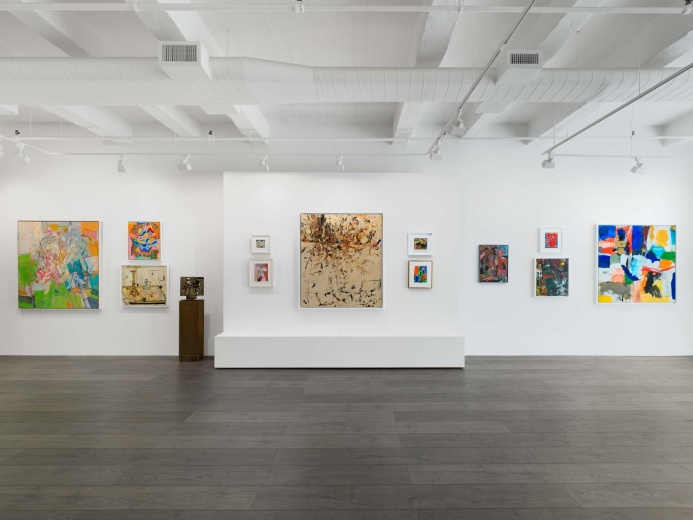
Installation View
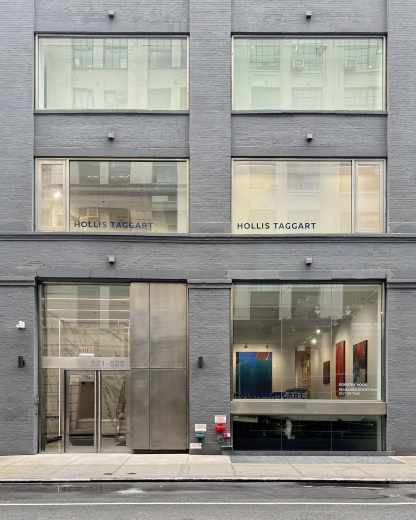
Hollis Taggart, Gallery's Exterior


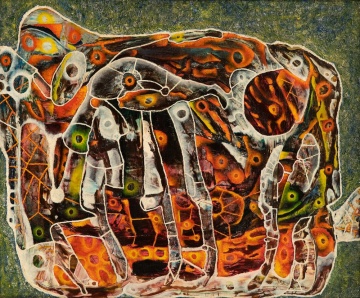
Charles Seliger
Charles Seliger: The Structure of Matter, A Centennial Exhibition
June 4, 2026 - July 10, 2026
Hollis Taggart is delighted to present its first solo exhibition of American artist Charles Seliger (1926-2009), in celebration of the centennial anniversary of the artist’s birth. The works on view span from 1944 to 1993, providing a rare, comprehensive view of the evolution of Seliger’s practice. Though often classified as a first-generation Abstract Expressionist, Seliger created work that complicated stylistic boundaries especially with the small scale of his works and his penchant for reworking the same paintings for long periods of time. Collaborating with the estate of the artist, Hollis Taggart has been involved in the process of bringing Seliger’s oeuvre back into public view. An opening reception will take place on Thursday, June 4 from 6 to 8pm in the first floor Annex space of Hollis Taggart’s flagship Chelsea location.
On view are Seliger’s intimately scaled paintings that capture the strange, evocative worlds of natural phenomena. His works were born from his deep reverence for nature and his desire to keep alive its mystery and creative impulses. “For me, to be successful in a painting, I must reflect the nature of becoming or metamorphosis,” he once explained. “I attempt through my imagination to make visible the structure of matter. . . I do not observe parts of nature under the microscope. I am not dissecting or analyzing. I have an emotional and intuitive awareness of nature.”
The earliest painting in the exhibition––created in 1944 by a precocious 18-year-old Seliger––already shows ample evidence of his hallmark abstract, organic imagery. The next year in 1945, Seliger mounted a solo exhibition at Peggy Guggenheim’s tastemaking Art of This Century Gallery, which in addition to Seliger represented Jackson Pollock and Mark Rothko. That year, Guggenheim praised the young Seliger in a letter to the British art critic Herbert Read: “Seliger’s painting is extremely organic, and his technique highly accomplished, and worked out with extreme care and in considerable detail. His show was very successful, and for over a year the Museum of Modern Art has been contemplating the purchase of a canvas, but being extremely cautious and rather conservative, they seem to be a little frightened of his youth.” (1) When the museum acquired Seliger’s Natural History: Form within Rock, a gift from August Hanniball, Jr, in June 1948, Seliger became the youngest artist to be represented in the Museum of Modern Art's permanent collection at the age of 20.
Throughout his life, Seliger captured details of his life, thoughts, and observations in journals that he began in 1954. These journals are now part of the permanent collection of the Morgan Library & Museum. The accompanying digital catalogue for this exhibition contains excerpts of Seliger’s diaristic reflections on his practice and the breadth of influences he voraciously assimilated, including the great naturalists Thoreau, John Burroughs, W.H. Hudson, J.H. Fabre and physicists Einstein, Heisenberg and Schrodinger. He also reflects on the milieu of Abstract Expressionism in the 1940s and 1950s in which he was immersed. Seliger began experimenting with Surrealist automatism in 1943, a technique he pursued through many decades. Like many of his contemporaries searching for a universal language of abstraction in the post-war period, Seliger turned to prehistoric ideas, symbols, and myth as a wellspring of imagery.
Critic Sam Hunter, reviewing the artist’s 1948 exhibition at Carlebach Gallery for the New York Times, commented that the artist’s work “carries the stamp of unborn mysteries and primitive rite.” Paintings by his colleagues Rothko and Pollock engulf viewers with their overwhelming scale, yet Seliger’s smaller paintings invite close contemplation and provide equally absorbing visual experiences. The artist pioneered a novel stylistic approach in which he bridged a certain naturalist approach with abstraction, which he described in these terms:
"My works, even when most abstract, reflect the natural world. Strata of the earth, forms relating to botany and biology and the ocean depths, all figure in the imagery of my work, no matter how abstract. The images are developed with a feeling for the intricacy of the structure of matter. There is a sense of something happening organically among the forms.” (2)
In creating his works, Seliger often undertook a laborious process, one which pairs automatist painting with an obsessive reworking of the surface. He began a composition by building up the surface with ample paint, and often other materials, such as wax, to achieve a dense picture plane; he then proceeded by scraping away layers to reveal different tones, shapes, and textures. He would repeat this process as many as seven times, a method that mimics the alternating sense of revelation and concealment offered by the finished compositions.
Like his friend Mark Tobey, Seliger regularly exhibited at the Willard Gallery in New York in the 1950s and 1960s. The Solomon R. Guggenheim Museum in New York mounted a retrospective exhibition in 1986 and currently holds the largest collection of Seliger’s work. Seliger was married to the artist Ruth Lewin for twenty-seven years until her passing in 1975. Together they raised two sons in suburban Mt. Vernon, New York.
Seliger’s work is represented in dozens of institutions, including the Whitney Museum of American Art, New York; Museum of Modern Art, New York; National Gallery of Art, Washington, DC; Metropolitan Museum of Art, New York; Art Institute of Chicago, Chicago; Phillips Collection, Washington, DC; Brooklyn Museum, Brooklyn; British Museum, London; High Museum of Art, Atlanta; Hirshhorn Museum and Sculpture Garden, Washington, DC; Carnegie Museum of Art, Pittsburgh; Morgan Library and Museum, New York; Norton Museum of Art, West Palm Beach; Seattle Art Museum, Seattle; Smithsonian American Art Museum, Washington, DC; among many others.
1.Peggy Guggenheim quoted in Francis V. O’Connor, Charles Seliger: Redefining Abstract Expressionism (Manchester, Vermont: Hudson Hills Press, 2002), 40.
2.Charles Seliger quoted in O’Connor, Charles Seliger, 13-14.
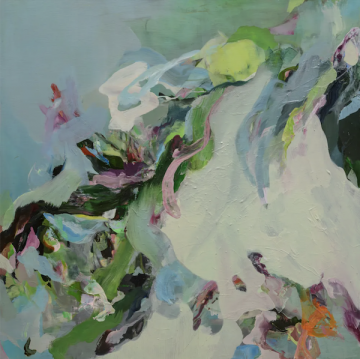
Hollis Heichemer
Hollis Heichemer: Moving in Stillness
May 28, 2026 - July 10, 2026
Hollis Taggart is pleased to present Moving in Stillness, the New Hampshire-based artist Hollis Heichemer’s fourth solo show with the gallery. The paintings on view reflect the artist’s ongoing desire to capture movement within a two-dimensional space. Moving in Stillness will be on view on the first floor of Hollis Taggart in Chelsea from May 28 through July 10, 2026, with an opening reception on Thursday, May 28 from 6 to 8 pm.
“Through painting,” Heichemer explains, “I am creating a space where one senses and experiences something which then alters our relationship to that moment.” Continuing with her interest in the shifts that we experience where imagination and reality are blurred,these new paintings explore the possibility of visualizing such shifts. Rather than trying to capture an event, Heichemer’s canvases alight on imperceptible shifts and movements that ultimately make up an entire life. “I'm reminding the viewer of their own space, the one that they spend time in, that they are connected to within themselves. It's the place where they're living from. The paintings connect them to a space inside that already exists, reminding them of the view of that infinite energy within that they may have forgotten about.”
Heichemer’s paintings, which luxuriate in rich gradations of greens and blues that shift from dark intensity to light-filled translucency, bring to mind the ancient Greek philosopher Heraclitus’s famous river analogy that hints at how reality is in a constant state of flux (“no man ever steps in the same river twice”). In Heichemer’s paintings, the colors appear active beneath the surface plane, and this sense of depth invites the viewer to step into, or travel within, the painting, as though there is an open path of color, light, and emotional evocations one can follow.
"The way I see paintings is a moment to meet yourself, a moment to synchronize with yourself,” the artist notes. “Because the only shared experience we have with others is being alive.” More important to Heichemer than witnessing how others metabolize her paintings is the simple fact that they have experienced her work, and therefore even for a fleeting, indirect moment, have linked their fate with hers.
Hollis Heichemer was born in Binghamton, New York in 1963. Her work has been the subject of solo exhibitions at Gross McCleaf and Rosenfeld Galleries in Philadelphia and J. Cacciola Gallery in New York. She has participated in a wide range of group exhibitions, including most recently at Stanek Gallery in Philadelphia and Dolby Chadwick Gallery in San Francisco. She lives and works in New Hampshire.
Rachel MacFarlane
Rachel MacFarlane: Afterlight
January 9, 2026 - February 21, 2026
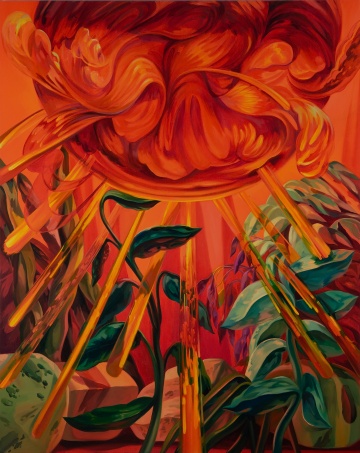
Hollis Taggart Downtown is pleased to present Afterlight, Rachel MacFarlane’s second solo exhibition with Hollis Taggart since joining its roster in 2022. The paintings in this exhibition speak to new forms of exploration in the artist’s practice: the richly jewel-toned landscapes for which MacFarlane is known retain their speculative aura while incorporating formal and conceptual possibilities of sunlight, particularly after her research trip to Spain in 2024. The exhibition will be on view at Hollis Taggart Downtown from January 9 to February 21, 2026, with an opening reception on Friday, January 9, from 6 to 8pm.
Around the time she was embarking on this new body of work, MacFarlane began rekindling knowledge of wild plants through attending foraging workshops. As a result – although the landscapes of MacFarlane’s paintings are based only loosely on memories of specific places – most of the plants and flora in these new paintings are real and identifiable: hoary mountain mint that is common to Jamaica Bay, olive trees in Spain (where farmers told her that they cannot be grown naturally anymore due to increased sunlight from recent climate changes), poppies, dandelions, and morning glories, to name a few. The smaller works on paper capture events in the landscape or specific natural phenomena.
Inspired by visionary painters like William Blake, Charles Burchfield, and Hilma af Klint, MacFarlane’s new works retool biblical, revelatory imagery of the unknowable and the sublime – as they relate to climate and the weather – into imaginary landscapes that look both pre-historic as well as post-human or survivalist. These new works suggest that such landscapes may lie in the not-too distant future, but at the same time look intensely speculative, as if straight out of a novel by Ursula K. Le Guin or Octavia Butler. MacFarlane’s landscapes might exist in the future in the aftermath of some cataclysmic event (as alluded to in the title of the show, Afterlight) but may not be accessible or viewable to any human.
MacFarlane’s works expand on the long-standing genre of landscape painting to account for current ecological pressure on natural spaces. Her works speak to our complicated relationship to the natural world, in light of climate crises and the proliferation of digital, simulated landscapes that act as a form of surrogate landscapes. To begin her studio process, MacFarlane constructs paper maquettes within small, shallow boxes to initiate each painting. These maquettes function almost as scientific experiments, as the artist plays with different light colors and shadows. The paintings then evolve into speculative fiction, illustrating the changing landscape or envisioning its potential future – one taken over by flora, fabricated and rebuilt, and full of unknown phenomena. New ideas for works are often triggered by expeditions to different sites; MacFarlane chooses places purposefully based on their ecologies to get a pulse on various kinds of current environmental changes.
Born in Scarborough, Canada, Rachel MacFarlane received her MFA from Rutgers University in 2016. She has had solo exhibitions at Norberg Hall Gallery, Calgary; MacLaren Art Centre, Barrie; Nicholas Metivier Gallery, Toronto; Super Dutchess Gallery, New York; Mason Gross Art Gallery, Rutgers University; Anna Leonowens Gallery, NSCAD Halifax; and Howard Park Institute, Toronto. Her works have also been exhibited in Florence, San Francisco, Philadelphia, and elsewhere. MacFarlane was awarded a 2021 and 2019 Canada Council for the Arts Explore and Create Grant, a 2019 Elizabeth Greenshields Foundation Grant, 2019 Vermont Studio Center Residency, 2015 Ontario Arts Council Grant, and the Doris McCarthy Artist-in-Residence at Fool's Paradise in Scarborough, Ontario, among numerous other awards. Her work is in public and private collections including Doris McCarthy Gallery at the University of Toronto, Jim and Susan Hill Collection, Equitable Bank, Stikeman Elliot, Royal Bank of Canada, Scotiabank, and The Donovan Collection at the University of Toronto. She has provided numerous artist talks including Concordia University, University of Toronto, OCAD University, NSCAD University and Sheridan College.